

AI Text Detection
Collection
Detectors of machine-written text and the corpus they were trained on. • 4 items • Updated
Litmus is a free detector of AI written text that says how sure it is.
Litmus reads a text and says whether it looks written by a person, by a language model (AI), or by both (mixed), and every reading carries its own uncertainty: the set of origins it cannot rule out at the 5% and 10% levels, and the chance of AI, a calibrated probability with a range. The model is a ternary (BitNet b1.58) encoder with a pair head, trained on the true origins of its training texts, that scores a text against a bank of reference texts and runs on a CPU, with no graphics card.
This release is an English detector: almost all of its training text is English, its held-out test text is English or of undetermined language, and other languages are not supported yet. Short texts are less reliable than long ones.
A reading is evidence about a text, never proof of who wrote it. The conformal sets and the interval exist so that no one reads more into a single number than it can carry.
| Developed by | Logan Hallee |
| Model type | BitNet b1.58 encoder: ternary weights (-1, 0, +1), 8-bit activations, block-local attention with blocks shifted by half on alternate layers, rotary positions, no global attention |
| Size | s512_l6 (width 512, 6 layers, 18.94M ternary weights) |
| Release file | model.safetensors, config.json (with the calibration table), tokenizer.json |
| Tokenizer | ModernBERT's (50,368 entries, byte-level, so no text is unknown) |
| Teacher | None: this release is trained on the true labels alone; labels alone read level with or ahead of distillation at equal steps (E4), and the second build has no teacher export |
| Origins | human (0), ai (1), mixed (2) |
| Languages | English; 98.8% of the training split is English and every held-out test text is English or undetermined, so this release is an English detector; other languages are read but not supported yet |
| License | PolyForm Noncommercial 1.0.0 for the weights, the reference bank and the calibration tables; source available, not open source |
| Required notice | Required Notice: Copyright Logan Hallee (https://github.com/lhallee/litmus) |
| Code | https://github.com/lhallee/litmus |
| Predecessor | lhallee/ai-vs-human-checker |
| Version | 1.2.0 |
Intended. Checking a text, a file or a folder of files for model-written passages, on a personal computer or in the browser, by anyone using it noncommercially: individuals, researchers, schools, universities, charities, public research bodies and government institutions. The page at the project's github.io site runs the model in the browser and sends the text nowhere.
Not licensed. Commercial use, which the license does not permit.
Our recommendations. What someone does with a reading is their own decision. We recommend:
scale * (q_a . k_b + q_b . k_a) / 2 + bias.student/SPEC.md, Surprise), which no verdict reads. Each training text is
presented anew at every draw (Markdown rendered or kept, dashes, quotes, wrapping and spacing in random styles, a
few synonyms swapped, and mid-sentence cuts, at the same rates for every origin), so that how a text was displayed
or collected says nothing of who wrote it. Earlier builds also distilled from a frozen encoder teacher; labels
alone read level with or ahead of distillation at equal steps, so this release has no teacher. The release is`s512_l6`, chosen by the maintainer for 1.1 (Logan, 2026-11-19: "512 hidden size 6 layers, that should be a good size") in place of 1.0.0's `s192_l4`, so that one encoder also serves as the masked language model; no size search was run for this release.r = mean / sum(mean) give the three-way reading; the score is 1 - r[human]. The bank holds vectors and
metadata (source, generator, domain, era, format, language), never text.calibration split alone, by origin and length group:
split conformal p-values per origin and the sets at 0.05 and 0.10; an inductive Venn-Abers probability of not
human with its interval; three-way probabilities; spread percentiles; an out-of-reference flag when the
closeness p-value is at or under 0.01; and how far the chance of AI moves between sources of text, which widens
its range (below). The tables ship in config.json.ceil(n / 8192) equal chunks, each a text of its own.
The verdict merges the chunks: p-values as min(1, 2 * mean), valid under any dependence (Vovk and Wang,
Biometrika 2020, arXiv 1212.4966); the probability as the mean, its interval widened by the chunks' disagreement;
a mixed-document signal at 0.05 / C per chunk. A heat map of 128-token cells comes from windows of 512 tokens
every 128, computed from running sums without a second pass. The map describes; the verdict decides.The verdict is taken from the set at 0.10: one origin names it, AI and mixed together read AI or mixed (human is
ruled out), human beside another origin reads uncertain, none reads unlike reference. The reading's place (strip) is P_ai + P_mixed / 2 from 0 (human) to 1 (AI), with the span of
what the 0.10 set cannot rule out. The engine, the app, and the page lead with one number, the chance of AI: the
probability of not human restated at even odds of human and not human, since the calibration texts of a length group
are not an even mix. The litmus strip is drawn from it, a mark at the chance and a pale band over its range.
The chance's range is the Venn-Abers interval restated the same way, then widened on each side by how far the chance moves from one source of text to another: 1.43 log odds, 4.2 times the odds, the half width that holds
90% of the pairings of one human source with one AI or mixed source, which is 4.2 times the odds in either direction. The interval alone says how well the calibration texts pin the number down and is under a point widefor most single texts; the shift between sources is the larger uncertainty. It is fitted on the calibration texts by their source, across 37 human sources and 75 AI and mixed sources: in each region of the chance, each source's texts are compared with the other sources' texts of the same lengths, and the spread of those shifts is taken with the part a source's sample size explains set apart (DerSimonian and Laird, Controlled Clinical Trials, 1986). With each source left out of the fit in turn, 90% of the human sources' shifts and 93% of the AI and mixed sources' shifts fell inside the half width fitted without them, which stayed between 1.37 and 1.49 log odds. On the 6,000 test passages, read once after the rule was fixed, 89% of the pairings of test sources fell inside the range.
| Chance of AI | Its range |
|---|---|
| 5% | 1% to 18% |
| 20% | 6% to 51% |
| 50% | 19% to 81% |
| 80% | 49% to 94% |
| 95% | 82% to 99% |
| 99% | 96% to 99% |
A private corpus compiled from public datasets only; nothing was generated for it. See the dataset card (lhallee/litmus-corpus) for the sources, the standard reading, the strata and the splits.
plain, markdown, list, table, code, math, chat), language, domain
and length bin on every row, and the classes balanced inside each cell as far as public data allows.train, validation (checkpoint), test (read once), calibration, and bank, the reference set's own
clusters, which no other set shares and which never train. The held-out sets were chosen from English and
undetermined-language text only.| Human | AI | Mixed | |
|---|---|---|---|
| Training rows | 5,900,740 | 5,077,061 | 153,889 |
| Bank vectors | 8,192 | 8,192 | 8,192 |
| Calibration rows | 19,994 | 19,994 | 18,024 |
| Test rows | 19,993 | 19,993 | 18,005 |
Bank construction: the withheld reference set, 8,192 texts an origin from clusters no other set holds and that never trained (the reference recipe), embedded again at every validation reading and by the export.
Every split and benchmark reports PR AUC, ROC AUC, balanced MCC (MCC on class-balanced subsamples at its best threshold) and the true positive rate at 1% and 5% false positive rate, each with a stratified bootstrap 95% interval, for three tasks: AI against human (mixed left out), AI or mixed against human, and mixed against human.
| Split | Reader | Task | PR AUC | ROC AUC | Balanced MCC | TPR at 1% FPR | TPR at 5% FPR |
|---|---|---|---|---|---|---|---|
| Test | Litmus, as released | AI against human | 0.937 | 0.934 | 0.697 | 0.530 | 0.671 |
| Test | Litmus, as released | AI or mixed against human | 0.945 | 0.900 | 0.621 | 0.385 | 0.557 |
| Test | Litmus, as released | Mixed against human | 0.861 | 0.866 | 0.559 | 0.240 | 0.442 |
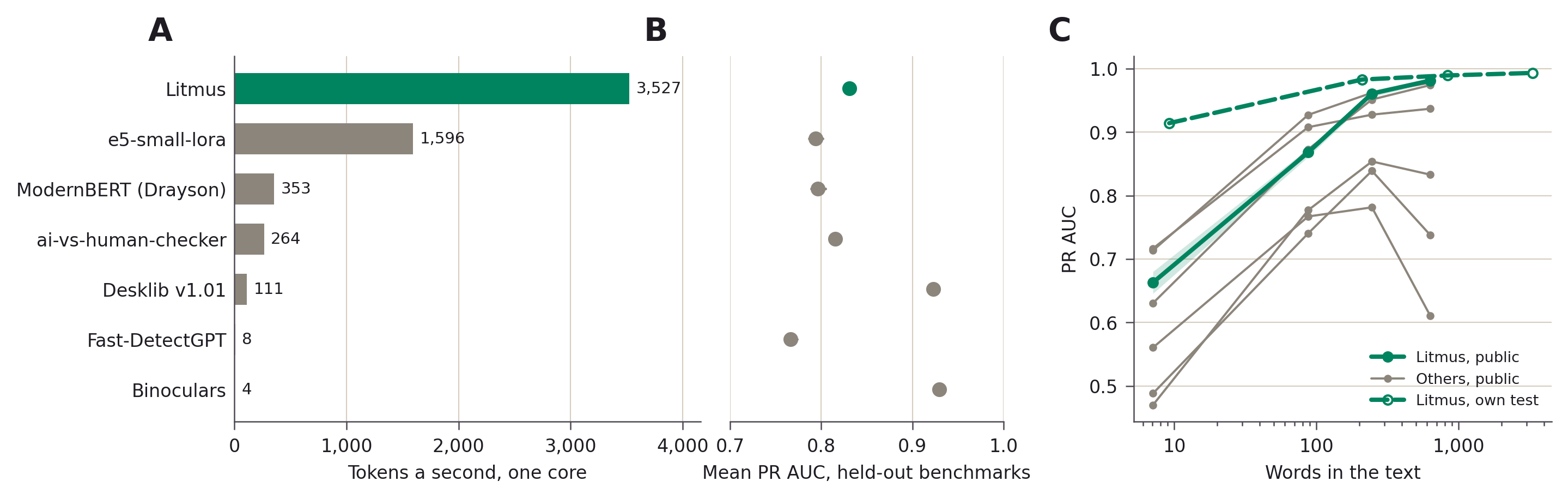
Speed on one CPU core (A), mean PR AUC over the public benchmarks that no compared detector trained on (B), and PR AUC by text length (C), every detector run on the same texts and timed on one processor core (the speed paragraph below names the processors). In C the solid lines are the pooled public benchmarks, and the dashed line is Litmus on its own held-out test split, its token bands placed in words by Litmus's measured tokens per word.
Outside benchmarks (one seeded sample of each, the same rows for every detector, official metric beside ours): RAID extra's Czech and German news (its code rows are training rows), MAGE test, unseen-domain and paraphrase sets, SemEval-2024 Task 8 A monolingual and multilingual, Beemo, APT-Eval and its human originals, MixSet, EditLens, DroidCollection, CoDET-M4, AuTexTification English and Spanish, and HC3. RAID itself is scored only by its leaderboard, and this release has not been submitted. The tables below are the benchmarks Litmus was scored on, with every rerun open detector beside it.
autextification_en
| Detector | PR AUC | ROC AUC | Balanced MCC | TPR at 1% FPR | AI / human texts |
|---|---|---|---|---|---|
| Binoculars | 0.914 (0.902 to 0.925) | 0.909 (0.898 to 0.919) | 0.683 (0.661 to 0.710) | 0.328 (0.227 to 0.426) | 1,510 / 1,490 |
| Desklib v1.01 | 0.954 (0.947 to 0.961) | 0.951 (0.943 to 0.958) | 0.768 (0.748 to 0.793) | 0.536 (0.499 to 0.605) | 1,510 / 1,490 |
| e5-small-lora | 0.769 (0.751 to 0.786) | 0.757 (0.740 to 0.773) | 0.386 (0.363 to 0.422) | 0.148 (0.120 to 0.183) | 1,510 / 1,490 |
| Fast-DetectGPT | 0.889 (0.878 to 0.899) | 0.861 (0.848 to 0.873) | 0.594 (0.573 to 0.624) | 0.425 (0.367 to 0.477) | 1,510 / 1,490 |
| ModernBERT RAID+MAGE (Drayson) | 0.851 (0.832 to 0.872) | 0.875 (0.862 to 0.887) | 0.620 (0.595 to 0.651) | 0.042 (0.012 to 0.148) | 1,510 / 1,490 |
| ai-vs-human-checker (predecessor) | 0.826 (0.811 to 0.841) | 0.815 (0.800 to 0.829) | 0.477 (0.456 to 0.510) | 0.224 (0.143 to 0.267) | 1,510 / 1,490 |
| Litmus | 0.839 (0.826 to 0.853) | 0.817 (0.801 to 0.832) | 0.510 (0.487 to 0.541) | 0.282 (0.221 to 0.352) | 1,510 / 1,490 |
autextification_es
| Detector | PR AUC | ROC AUC | Balanced MCC | TPR at 1% FPR | AI / human texts |
|---|---|---|---|---|---|
| Binoculars | 0.922 (0.914 to 0.930) | 0.892 (0.881 to 0.904) | 0.639 (0.620 to 0.670) | 0.430 (0.354 to 0.490) | 1,660 / 1,340 |
| Desklib v1.01 | 0.908 (0.898 to 0.918) | 0.887 (0.876 to 0.898) | 0.595 (0.573 to 0.625) | 0.353 (0.308 to 0.404) | 1,660 / 1,340 |
| e5-small-lora | 0.680 (0.662 to 0.699) | 0.620 (0.600 to 0.639) | 0.194 (0.171 to 0.232) | 0.062 (0.048 to 0.081) | 1,660 / 1,340 |
| Fast-DetectGPT | 0.869 (0.857 to 0.880) | 0.831 (0.817 to 0.845) | 0.515 (0.490 to 0.549) | 0.278 (0.221 to 0.330) | 1,660 / 1,340 |
| ModernBERT RAID+MAGE (Drayson) | 0.613 (0.595 to 0.634) | 0.538 (0.518 to 0.560) | 0.107 (0.090 to 0.146) | 0.044 (0.020 to 0.058) | 1,660 / 1,340 |
| ai-vs-human-checker (predecessor) | 0.563 (0.547 to 0.583) | 0.519 (0.498 to 0.540) | 0.083 (0.054 to 0.123) | 0.010 (0.003 to 0.024) | 1,660 / 1,340 |
| Litmus | 0.619 (0.601 to 0.636) | 0.554 (0.534 to 0.574) | 0.128 (0.104 to 0.165) | 0.022 (0.015 to 0.029) | 1,660 / 1,340 |
Beemo
| Detector | PR AUC | ROC AUC | Balanced MCC | TPR at 1% FPR | AI / human texts |
|---|---|---|---|---|---|
| Binoculars | 0.960 (0.954 to 0.966) | 0.788 (0.763 to 0.814) | 0.459 (0.436 to 0.535) | 0.125 (0.064 to 0.181) | 2,352 / 327 |
| Desklib v1.01 | 0.959 (0.950 to 0.966) | 0.797 (0.771 to 0.822) | 0.500 (0.455 to 0.556) | 0.050 (0.014 to 0.136) | 2,352 / 327 |
| e5-small-lora | 0.926 (0.915 to 0.937) | 0.690 (0.659 to 0.719) | 0.326 (0.277 to 0.378) | 0.015 (0.004 to 0.031) | 2,352 / 327 |
| Fast-DetectGPT | 0.901 (0.890 to 0.912) | 0.549 (0.515 to 0.582) | 0.115 (0.098 to 0.185) | 0.040 (0.025 to 0.060) | 2,352 / 327 |
| ModernBERT RAID+MAGE (Drayson) | 0.917 (0.904 to 0.929) | 0.678 (0.642 to 0.710) | 0.336 (0.292 to 0.400) | 0.010 (0.003 to 0.019) | 2,352 / 327 |
| ai-vs-human-checker (predecessor) | 0.952 (0.943 to 0.961) | 0.780 (0.756 to 0.807) | 0.449 (0.406 to 0.501) | 0.011 (0.005 to 0.133) | 2,352 / 327 |
| Litmus | 0.965 (0.956 to 0.972) | 0.829 (0.800 to 0.854) | 0.565 (0.525 to 0.621) | 0.082 (0.000 to 0.108) | 2,352 / 327 |
CoDET-M4
| Detector | PR AUC | ROC AUC | Balanced MCC | TPR at 1% FPR | AI / human texts |
|---|---|---|---|---|---|
| Binoculars | 0.906 (0.896 to 0.917) | 0.886 (0.873 to 0.899) | 0.662 (0.637 to 0.692) | 0.357 (0.294 to 0.446) | 1,522 / 1,477 |
| Desklib v1.01 | 0.755 (0.735 to 0.776) | 0.772 (0.756 to 0.789) | 0.422 (0.396 to 0.454) | 0.068 (0.051 to 0.089) | 1,522 / 1,477 |
| e5-small-lora | 0.580 (0.561 to 0.600) | 0.614 (0.594 to 0.633) | 0.212 (0.186 to 0.249) | 0.009 (0.003 to 0.022) | 1,522 / 1,477 |
| Fast-DetectGPT | 0.499 (0.486 to 0.515) | 0.535 (0.515 to 0.556) | 0.134 (0.110 to 0.171) | 0.001 (0.000 to 0.004) | 1,522 / 1,477 |
| ModernBERT RAID+MAGE (Drayson) | 0.454 (0.440 to 0.469) | 0.429 (0.409 to 0.450) | 0.057 (0.029 to 0.091) | 0.004 (0.001 to 0.009) | 1,522 / 1,477 |
| ai-vs-human-checker (predecessor) | 0.590 (0.570 to 0.611) | 0.598 (0.578 to 0.618) | 0.172 (0.146 to 0.210) | 0.026 (0.010 to 0.044) | 1,522 / 1,477 |
| Litmus | 0.669 (0.650 to 0.690) | 0.722 (0.702 to 0.740) | 0.450 (0.425 to 0.483) | 0.044 (0.031 to 0.059) | 1,522 / 1,477 |
DroidCollection
| Detector | PR AUC | ROC AUC | Balanced MCC | TPR at 1% FPR | AI / human texts |
|---|---|---|---|---|---|
| Binoculars | 0.844 (0.829 to 0.860) | 0.831 (0.815 to 0.848) | 0.572 (0.549 to 0.606) | 0.347 (0.204 to 0.421) | 1,205 / 1,430 |
| Desklib v1.01 | 0.607 (0.583 to 0.632) | 0.665 (0.644 to 0.685) | 0.256 (0.228 to 0.299) | 0.037 (0.025 to 0.056) | 1,205 / 1,430 |
| e5-small-lora | 0.493 (0.474 to 0.517) | 0.519 (0.497 to 0.542) | 0.070 (0.055 to 0.116) | 0.019 (0.008 to 0.038) | 1,205 / 1,430 |
| Fast-DetectGPT | 0.571 (0.549 to 0.599) | 0.609 (0.588 to 0.630) | 0.177 (0.161 to 0.223) | 0.022 (0.014 to 0.048) | 1,205 / 1,430 |
| ModernBERT RAID+MAGE (Drayson) | 0.412 (0.398 to 0.428) | 0.446 (0.424 to 0.469) | 0.097 (0.069 to 0.135) | 0.008 (0.003 to 0.014) | 1,205 / 1,430 |
| ai-vs-human-checker (predecessor) | 0.572 (0.550 to 0.597) | 0.604 (0.583 to 0.625) | 0.189 (0.156 to 0.226) | 0.029 (0.018 to 0.053) | 1,205 / 1,430 |
| Litmus † | 0.816 (0.799 to 0.831) | 0.818 (0.801 to 0.832) | 0.483 (0.461 to 0.520) | 0.309 (0.258 to 0.348) | 1,205 / 1,430 |
editlens
| Detector | PR AUC | ROC AUC | Balanced MCC | TPR at 1% FPR | AI / human texts |
|---|---|---|---|---|---|
| Binoculars | 0.959 (0.952 to 0.966) | 0.952 (0.943 to 0.961) | 0.774 (0.753 to 0.803) | 0.638 (0.576 to 0.718) | 999 / 996 |
| Desklib v1.01 | 0.989 (0.986 to 0.992) | 0.988 (0.984 to 0.991) | 0.899 (0.882 to 0.920) | 0.866 (0.829 to 0.906) | 999 / 996 |
| e5-small-lora | 0.850 (0.830 to 0.869) | 0.846 (0.829 to 0.862) | 0.559 (0.533 to 0.597) | 0.169 (0.078 to 0.230) | 999 / 996 |
| Fast-DetectGPT | 0.727 (0.706 to 0.749) | 0.685 (0.661 to 0.707) | 0.325 (0.295 to 0.369) | 0.167 (0.134 to 0.202) | 999 / 996 |
| ModernBERT RAID+MAGE (Drayson) | 0.908 (0.886 to 0.931) | 0.946 (0.934 to 0.956) | 0.830 (0.805 to 0.857) | 0.080 (0.035 to 0.177) | 999 / 996 |
| ai-vs-human-checker (predecessor) | 0.994 (0.992 to 0.996) | 0.993 (0.989 to 0.996) | 0.935 (0.923 to 0.952) | 0.931 (0.896 to 0.953) | 999 / 996 |
| Litmus | 0.995 (0.990 to 0.999) | 0.996 (0.993 to 0.998) | 0.971 (0.962 to 0.982) | 0.977 (0.942 to 0.989) | 999 / 996 |
hc3
| Detector | PR AUC | ROC AUC | Balanced MCC | TPR at 1% FPR | AI / human texts |
|---|---|---|---|---|---|
| Binoculars | 0.988 (0.981 to 0.993) | 0.993 (0.988 to 0.996) | 0.957 (0.947 to 0.969) | 0.952 (0.902 to 0.969) | 988 / 2,012 |
| Desklib v1.01 | 0.998 (0.996 to 0.999) | 0.999 (0.997 to 0.999) | 0.968 (0.962 to 0.979) | 0.977 (0.962 to 0.987) | 988 / 2,012 |
| e5-small-lora | 0.886 (0.869 to 0.902) | 0.934 (0.924 to 0.943) | 0.744 (0.722 to 0.772) | 0.382 (0.343 to 0.474) | 988 / 2,012 |
| Fast-DetectGPT | 0.662 (0.635 to 0.689) | 0.767 (0.748 to 0.787) | 0.456 (0.423 to 0.488) | 0.141 (0.099 to 0.179) | 988 / 2,012 |
| ModernBERT RAID+MAGE (Drayson) | 0.954 (0.935 to 0.974) | 0.988 (0.984 to 0.991) | 0.916 (0.905 to 0.932) | 0.786 (0.572 to 0.843) | 988 / 2,012 |
| ai-vs-human-checker (predecessor) | 0.998 (0.996 to 0.999) | 0.999 (0.998 to 0.999) | 0.970 (0.960 to 0.979) | 0.977 (0.959 to 0.987) | 988 / 2,012 |
| Litmus | 0.990 (0.986 to 0.993) | 0.993 (0.990 to 0.996) | 0.946 (0.931 to 0.958) | 0.936 (0.920 to 0.962) | 988 / 2,012 |
MAGE
| Detector | PR AUC | ROC AUC | Balanced MCC | TPR at 1% FPR | AI / human texts |
|---|---|---|---|---|---|
| Binoculars | 0.682 (0.660 to 0.703) | 0.624 (0.602 to 0.646) | 0.378 (0.350 to 0.407) | 0.095 (0.062 to 0.170) | 1,415 / 1,585 |
| Desklib v1.01 | 0.930 (0.922 to 0.938) | 0.929 (0.920 to 0.937) | 0.690 (0.668 to 0.719) | 0.543 (0.496 to 0.599) | 1,415 / 1,585 |
| e5-small-lora | 0.720 (0.695 to 0.743) | 0.761 (0.743 to 0.778) | 0.381 (0.360 to 0.414) | 0.039 (0.009 to 0.077) | 1,415 / 1,585 |
| Fast-DetectGPT | 0.648 (0.628 to 0.666) | 0.569 (0.548 to 0.589) | 0.318 (0.295 to 0.348) | 0.196 (0.166 to 0.227) | 1,415 / 1,585 |
| ModernBERT RAID+MAGE (Drayson) † | 0.984 (0.977 to 0.989) | 0.986 (0.982 to 0.989) | 0.899 (0.885 to 0.915) | 0.823 (0.764 to 0.859) | 1,415 / 1,585 |
| ai-vs-human-checker (predecessor) † | 0.868 (0.856 to 0.880) | 0.853 (0.839 to 0.867) | 0.568 (0.543 to 0.599) | 0.413 (0.383 to 0.451) | 1,415 / 1,585 |
| Litmus † | 0.836 (0.822 to 0.850) | 0.829 (0.816 to 0.844) | 0.497 (0.474 to 0.528) | 0.312 (0.285 to 0.352) | 1,415 / 1,585 |
MAGE unseen
| Detector | PR AUC | ROC AUC | Balanced MCC | TPR at 1% FPR | AI / human texts |
|---|---|---|---|---|---|
| Binoculars | 0.977 (0.971 to 0.982) | 0.969 (0.961 to 0.977) | 0.854 (0.834 to 0.882) | 0.764 (0.724 to 0.819) | 800 / 762 |
| Desklib v1.01 | 0.990 (0.987 to 0.993) | 0.988 (0.983 to 0.991) | 0.884 (0.866 to 0.906) | 0.860 (0.825 to 0.902) | 800 / 762 |
| e5-small-lora | 0.950 (0.940 to 0.959) | 0.951 (0.941 to 0.960) | 0.762 (0.740 to 0.795) | 0.472 (0.401 to 0.549) | 800 / 762 |
| Fast-DetectGPT | 0.721 (0.695 to 0.749) | 0.638 (0.609 to 0.666) | 0.374 (0.333 to 0.423) | 0.124 (0.075 to 0.174) | 800 / 762 |
| ModernBERT RAID+MAGE (Drayson) † | 0.900 (0.876 to 0.927) | 0.929 (0.915 to 0.941) | 0.734 (0.703 to 0.768) | 0.102 (0.043 to 0.215) | 800 / 762 |
| ai-vs-human-checker (predecessor) † | 0.975 (0.966 to 0.981) | 0.973 (0.966 to 0.979) | 0.815 (0.796 to 0.848) | 0.716 (0.624 to 0.784) | 800 / 762 |
| Litmus | 0.967 (0.958 to 0.974) | 0.967 (0.959 to 0.974) | 0.812 (0.784 to 0.838) | 0.710 (0.545 to 0.738) | 800 / 762 |
MAGE paraphrased
| Detector | PR AUC | ROC AUC | Balanced MCC | TPR at 1% FPR | AI / human texts |
|---|---|---|---|---|---|
| Binoculars | 0.802 (0.785 to 0.820) | 0.662 (0.640 to 0.685) | 0.259 (0.223 to 0.299) | 0.059 (0.046 to 0.087) | 1,600 / 762 |
| Desklib v1.01 | 0.935 (0.927 to 0.943) | 0.873 (0.858 to 0.887) | 0.573 (0.542 to 0.608) | 0.334 (0.286 to 0.411) | 1,600 / 762 |
| e5-small-lora | 0.913 (0.904 to 0.922) | 0.833 (0.817 to 0.848) | 0.528 (0.486 to 0.556) | 0.275 (0.208 to 0.324) | 1,600 / 762 |
| Fast-DetectGPT | 0.613 (0.599 to 0.630) | 0.420 (0.394 to 0.446) | 0.000 (0.000 to 0.000) | 0.000 (0.000 to 0.001) | 1,600 / 762 |
| ModernBERT RAID+MAGE (Drayson) † | 0.822 (0.806 to 0.841) | 0.719 (0.698 to 0.743) | 0.345 (0.306 to 0.385) | 0.034 (0.015 to 0.072) | 1,600 / 762 |
| ai-vs-human-checker (predecessor) † | 0.941 (0.932 to 0.950) | 0.891 (0.876 to 0.904) | 0.616 (0.583 to 0.652) | 0.341 (0.265 to 0.424) | 1,600 / 762 |
| Litmus | 0.943 (0.935 to 0.951) | 0.898 (0.884 to 0.911) | 0.620 (0.591 to 0.658) | 0.414 (0.284 to 0.438) | 1,600 / 762 |
MixSet
| Detector | PR AUC | ROC AUC | Balanced MCC | TPR at 1% FPR | AI / human texts |
|---|---|---|---|---|---|
| Binoculars | 0.859 (0.837 to 0.879) | 0.499 (0.437 to 0.557) | 0.210 (0.181 to 0.285) | 0.100 (0.072 to 0.164) | 500 / 100 |
| Desklib v1.01 | 0.897 (0.871 to 0.919) | 0.660 (0.600 to 0.718) | 0.322 (0.222 to 0.409) | 0.074 (0.028 to 0.108) | 500 / 100 |
| e5-small-lora | 0.865 (0.838 to 0.896) | 0.607 (0.544 to 0.675) | 0.212 (0.152 to 0.342) | 0.010 (0.002 to 0.064) | 500 / 100 |
| Fast-DetectGPT | 0.817 (0.790 to 0.844) | 0.420 (0.361 to 0.481) | 0.058 (0.024 to 0.175) | 0.024 (0.002 to 0.076) | 500 / 100 |
| ModernBERT RAID+MAGE (Drayson) | 0.875 (0.843 to 0.908) | 0.636 (0.574 to 0.694) | 0.287 (0.200 to 0.397) | 0.004 (0.000 to 0.032) | 500 / 100 |
| ai-vs-human-checker (predecessor) | 0.783 (0.756 to 0.813) | 0.463 (0.391 to 0.527) | 0.108 (0.043 to 0.191) | 0.000 (0.000 to 0.000) | 500 / 100 |
| Litmus | 0.738 (0.718 to 0.759) | 0.285 (0.218 to 0.348) | 0.071 (0.000 to 0.123) | 0.000 (0.000 to 0.000) | 500 / 100 |
RAID extra (cs, de)
| Detector | PR AUC | ROC AUC | Balanced MCC | TPR at 1% FPR | AI / human texts |
|---|---|---|---|---|---|
| Binoculars | 0.991 (0.990 to 0.993) | 0.761 (0.727 to 0.793) | 0.531 (0.449 to 0.609) | 0.292 (0.278 to 0.402) | 2,911 / 88 |
| Desklib v1.01 † | 0.996 (0.994 to 0.997) | 0.883 (0.846 to 0.919) | 0.687 (0.602 to 0.773) | 0.365 (0.350 to 0.486) | 2,911 / 88 |
| e5-small-lora † | 0.992 (0.990 to 0.993) | 0.773 (0.737 to 0.806) | 0.506 (0.479 to 0.603) | 0.388 (0.372 to 0.464) | 2,911 / 88 |
| Fast-DetectGPT | 0.979 (0.972 to 0.984) | 0.600 (0.547 to 0.647) | 0.324 (0.234 to 0.425) | 0.001 (0.000 to 0.055) | 2,911 / 88 |
| ModernBERT RAID+MAGE (Drayson) † | 0.994 (0.991 to 0.997) | 0.885 (0.837 to 0.929) | 0.739 (0.668 to 0.811) | 0.091 (0.081 to 0.170) | 2,911 / 88 |
| ai-vs-human-checker (predecessor) † | 0.987 (0.985 to 0.990) | 0.700 (0.656 to 0.747) | 0.368 (0.308 to 0.478) | 0.122 (0.110 to 0.288) | 2,911 / 88 |
| Litmus | 0.996 (0.995 to 0.997) | 0.886 (0.860 to 0.910) | 0.655 (0.587 to 0.717) | 0.495 (0.477 to 0.614) | 2,911 / 88 |
SemEval-24 mono
| Detector | PR AUC | ROC AUC | Balanced MCC | TPR at 1% FPR | AI / human texts |
|---|---|---|---|---|---|
| Binoculars | 0.940 (0.932 to 0.947) | 0.896 (0.883 to 0.909) | 0.812 (0.795 to 0.831) | 0.805 (0.769 to 0.828) | 1,574 / 1,426 |
| Desklib v1.01 | 1.000 (0.999 to 1.000) | 0.999 (0.999 to 1.000) | 0.989 (0.984 to 0.994) | 0.997 (0.989 to 0.999) | 1,574 / 1,426 |
| e5-small-lora | 0.922 (0.913 to 0.931) | 0.918 (0.908 to 0.927) | 0.681 (0.661 to 0.710) | 0.356 (0.302 to 0.451) | 1,574 / 1,426 |
| Fast-DetectGPT | 0.476 (0.461 to 0.494) | 0.336 (0.318 to 0.356) | 0.073 (0.051 to 0.110) | 0.019 (0.011 to 0.042) | 1,574 / 1,426 |
| ModernBERT RAID+MAGE (Drayson) | 0.897 (0.878 to 0.917) | 0.950 (0.940 to 0.959) | 0.857 (0.839 to 0.875) | 0.001 (0.000 to 0.008) | 1,574 / 1,426 |
| ai-vs-human-checker (predecessor) † | 0.997 (0.996 to 0.998) | 0.996 (0.993 to 0.998) | 0.975 (0.968 to 0.982) | 0.982 (0.975 to 0.989) | 1,574 / 1,426 |
| Litmus † | 0.995 (0.994 to 0.997) | 0.994 (0.992 to 0.996) | 0.942 (0.932 to 0.954) | 0.947 (0.935 to 0.959) | 1,574 / 1,426 |
SemEval-24 multi
| Detector | PR AUC | ROC AUC | Balanced MCC | TPR at 1% FPR | AI / human texts |
|---|---|---|---|---|---|
| Binoculars | 0.929 (0.921 to 0.936) | 0.887 (0.875 to 0.900) | 0.707 (0.687 to 0.730) | 0.651 (0.621 to 0.693) | 1,594 / 1,406 |
| Desklib v1.01 | 0.973 (0.969 to 0.977) | 0.964 (0.958 to 0.969) | 0.812 (0.795 to 0.834) | 0.780 (0.738 to 0.812) | 1,594 / 1,406 |
| e5-small-lora | 0.827 (0.815 to 0.840) | 0.758 (0.742 to 0.775) | 0.505 (0.482 to 0.533) | 0.361 (0.291 to 0.392) | 1,594 / 1,406 |
| Fast-DetectGPT | 0.633 (0.616 to 0.651) | 0.489 (0.468 to 0.511) | 0.229 (0.213 to 0.262) | 0.119 (0.100 to 0.142) | 1,594 / 1,406 |
| ModernBERT RAID+MAGE (Drayson) | 0.826 (0.806 to 0.847) | 0.842 (0.827 to 0.857) | 0.619 (0.592 to 0.647) | 0.004 (0.000 to 0.027) | 1,594 / 1,406 |
| ai-vs-human-checker (predecessor) † | 0.947 (0.941 to 0.953) | 0.926 (0.917 to 0.935) | 0.724 (0.704 to 0.750) | 0.662 (0.627 to 0.691) | 1,594 / 1,406 |
| Litmus † | 0.983 (0.981 to 0.986) | 0.981 (0.977 to 0.984) | 0.867 (0.852 to 0.885) | 0.806 (0.759 to 0.851) | 1,594 / 1,406 |
Litmus test
| Detector | PR AUC | ROC AUC | Balanced MCC | TPR at 1% FPR | AI / human texts |
|---|---|---|---|---|---|
| Litmus | 0.937 (0.931 to 0.944) | 0.934 (0.926 to 0.941) | 0.697 (0.677 to 0.720) | 0.530 (0.494 to 0.572) | 2,000 / 2,000 |
† trained on this benchmark (its training split, or its test texts). ‡ read a different sample of the benchmark than the other detectors, so its intervals are not paired with theirs. Intervals are bootstrap 95%.
What the comparison cannot claim: protocols differ between sources, so quoted numbers appear only beside the same benchmark, subset and metric; some other detectors trained on RAID or MAGE; Litmus's held-out claim covers the cataloged benchmark splits only; one sample per benchmark supports its intervals and no more.
The conformal guarantee: for human text exchangeable with the calibration set, the share called not human at level
a is at most a, in each length group. It covers text from the same sources, formats, languages and generators in
the same mix, and nothing else.
| Where | Coverage at 0.05 | Coverage at 0.10 | Mean set size at 0.10 | Human called not human at 0.05 |
|---|---|---|---|---|
| Test, all | 94.3% | 90.1% | 1.87 | 7.4% |
| Test, 1-128 tokens | 94.6% | 90.5% | 2.03 | 7.7% |
| Test, 129-512 tokens | 94.0% | 89.4% | 1.54 | 5.4% |
| Test, 513-2048 tokens | 93.3% | 88.9% | 1.40 | 9.0% |
| Test, 2049-8192 tokens | 93.4% | 86.8% | 1.46 | 6.7% |
| Long documents, merged chunks | 92.9% | 85.7% | 1.43 | 4.8% |
Measured on releases of the nine candidate sizes with random weights and a bank of 4,096 texts per origin (engine README): AMD Ryzen 7 3800X, Windows 10, one core, AVX2, the fastest of 5 runs on a machine 40 to 45% busy with other work. A whole scoring call ran at 4,214 (d384 L8) to 21,926 (d192 L4) tokens per second on 8,192 tokens, flat from 1,024 to 131,072 tokens, with a process peak of 56 to 70 MB. In WebAssembly (Node 22, one thread) d192 L4 scored 3,400 to 4,000 tokens per second.
The released size (`s512_l6`) reads 4,920 tokens per second on an 8,192-token text with a process peak of 63.1 MB, on AMD Ryzen 7 3800X 8-Core Processor under Windows 10 (one core, avx2 kernels). Its release files are 18.5 MB, and its single-core cost is 349 ms per 1,000 words on one core of Arm Neoverse-V2, beside the other detectors in the benchmark tables (timed on one core of Intel(R) Xeon(R) Platinum 8358 CPU @ 2.60GHz).Command line: litmus score [--json] [--map] [--explain] <file | folder | -> with --model pointing to the release
folder. Python:
import litmus_engine

model = litmus_engine.Model.from_path("path/to/release")
reading = model.score(text)
reading["label"]                                   # "human", "AI", "mixed", "AI or mixed", "uncertain" or "unlike reference"
reading["chance"]["value"], reading["chance"]["interval"]  # the chance of AI and its range, widened between sources
reading["verdict"]["probability"], reading["verdict"]["interval"], reading["verdict"]["strip"]
surprise = model.surprise(text)                    # a second pass, through the masked language head
surprise["mean_log_probability"], surprise["perplexity"], surprise["percentile"]  # percentile: human, AI, mixed
Every reading can explain itself: the calibration counts behind each p-value ("of n human calibration texts of this
length, k read at most this human"), the five nearest bank texts with their metadata, and each chunk's reading.
PolyForm Noncommercial 1.0.0 (https://polyformproject.org/licenses/noncommercial/1.0.0). Pass the license and the Required Notice line along with every copy. Documentation and figures are CC BY-NC 4.0.