

Laya
Multilingual, non-autoregressive System 1 decision model. Give it a state (text, email, ticket, or JSON) and typed questions; it returns typed answers with mathematically calibrated probabilities in a single forward pass (~33 ms) across 100+ languages. Trained with reinforcement learning against strictly proper scoring rules (RLCD), so reporting honest probabilities is the only way to maximise reward. It never generates text, so there is nothing to parse and nothing to hallucinate.
This repo holds all three checkpoints and is the hub for the family. The English checkpoint is at the repo root; the other two are bundled subfolders, and only the one you request is downloaded:
| Checkpoint | Backbone Encoder | Params | Context | Best at |
|---|---|---|---|---|
convaiinnovations/laya (this repo root) |
ModernBERT-large | 421M | 512 | English text, guardrails, email triage |
convaiinnovations/laya-multilingual |
mmBERT-base | 322M | 1024 (up to 8k) | 100+ languages, ~2.2x faster |
convaiinnovations/laya-typed-decisions |
ModernBERT-large | 421M | 1024 | the four typed-decisions workflows (0.766 acc) |
Quickstart: Route Mode (Recommended)
Laya's built-in Router is the recommended way to use Laya in production. It evaluates any state in any language, automatically detects scripts and languages in sub-milliseconds, and dispatches to the optimal checkpoint in a single forward pass.
pip install laya
import laya
from laya import Router

# Preload checkpoints into memory for instant sub-35ms routing
router = Router(preload=True)

state = {
    "from": "user@acme.com",
    "subject": "Duplicate charge on invoice #4411",
    "body": "Hi, we were billed twice for March. Please refund the duplicate today or we will cancel our plan."
}

questions = {
    "department": {
        "type": "choice",
        "instructions": "Which department should handle this request?",
        "criteria": {
            "billing": "invoices, payments, refunds",
            "technical": "bugs, outages, system errors",
            "sales": "pricing, new contracts",
            "other": "everything else"
        }
    },
    "urgency": {
        "type": "score",
        "instructions": "How urgent is this request?",
        "criteria": ["not urgent", "soon", "critical deadline or blocking issue"]
    },
    "churn_risk": {
        "type": "noul",
        "instructions": "Does the user threaten to cancel or leave?"
    },
    "refund_requested": {
        "type": "noul",
        "instructions": "Does the user explicitly request a refund?"
    }
}

# 1. English state -> automatically routed to ModernBERT-large (39.5 ms)
res_en = router.predict(state, questions)
print("Department :", res_en["answers"]["department"]["choice"])  # -> billing (confidence: 0.94)
print("Routing    :", res_en["routing"]["model"])                 # -> english

# 2. Hindi state -> automatically routed to mmBERT-base (100+ languages, 32.8 ms)
res_hi = router.predict({"body": "मुझसे दो बार शुल्क लिया गया, कृपया पैसे वापस करें।"}, questions)
print("Department :", res_hi["answers"]["department"]["choice"])  # -> billing (confidence: 0.86)
print("Routing    :", res_hi["routing"]["model"])                 # -> multilingual

# 3. Explicit override when you already know the checkpoint
res_td = router.predict(state, questions, model="typed-decisions")
Every result carries full routing metadata explaining why the choice was made:
res_hi["routing"]
# {
#   'model': 'multilingual',
#   'repo': 'convaiinnovations/laya/multilingual',
#   'reason': 'non-Latin script (devanagari, 100% of letters); the English checkpoint cannot read it'
# }
Why Route: The Evidence
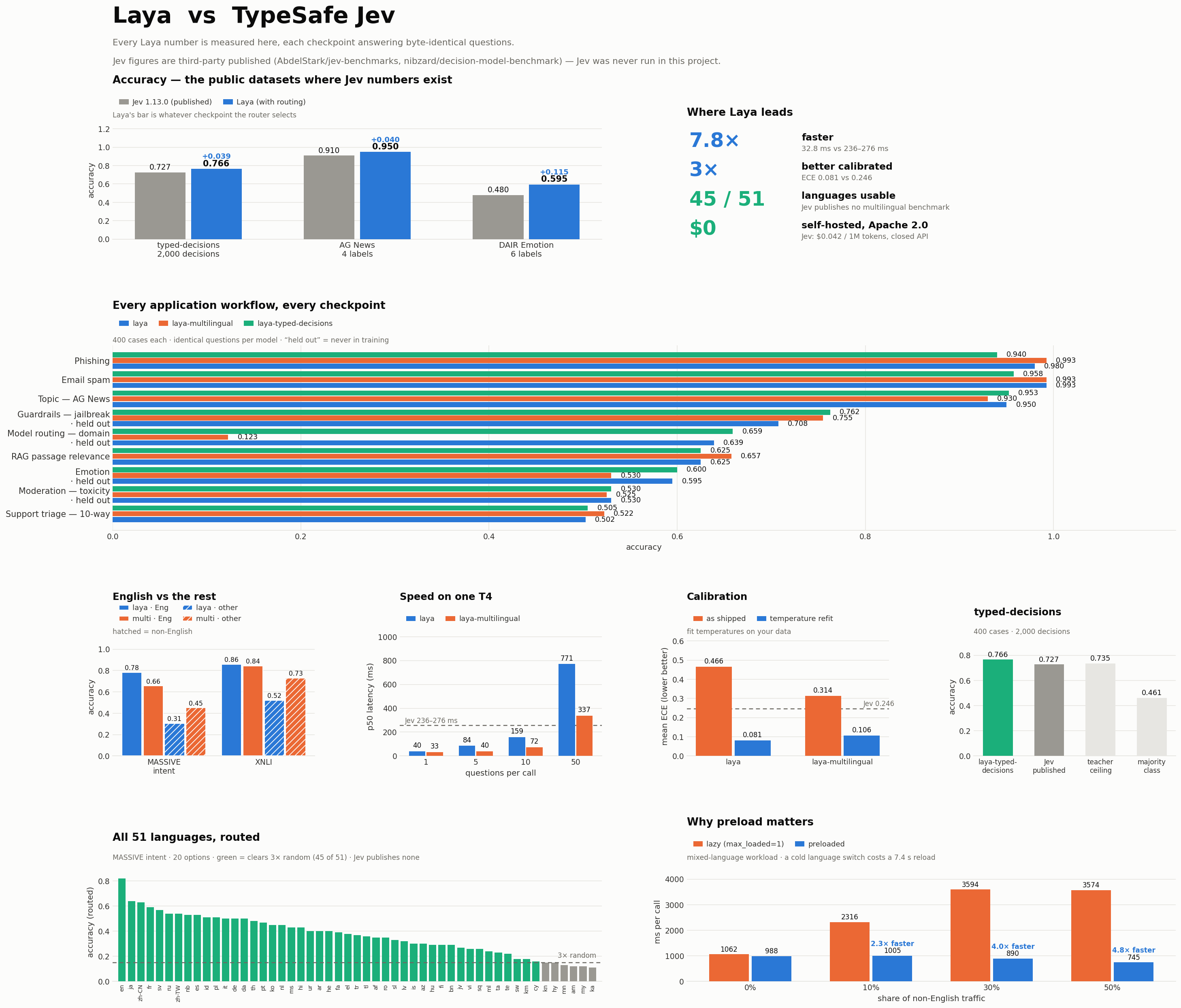
On a shared benchmark (17,416 questions, one T4 GPU, identical questions per model):
| Benchmark / Task | English (laya) |
Multilingual (laya-multilingual) |
Router (Routed) |
|---|---|---|---|
| MASSIVE intent, English | 0.783 | 0.657 | 0.783 |
| MASSIVE intent, 13 other languages | 0.306 | 0.451 | 0.451 |
| XNLI, English | 0.860 | 0.843 | 0.860 |
| XNLI, 14 other languages | 0.521 | 0.731 | 0.731 |
| Languages usable (>3x random) | 23 / 51 | 45 / 51 | 45 / 51 |
| Latency, 1 question (T4 GPU) | 39.5 ms | 32.8 ms | 32.8 ms |
| Latency, 10 questions batched | 158.6 ms | 72.3 ms | 72.3 ms |
The English checkpoint collapses on non-Latin scripts (Khmer scores 0.000 accuracy at 0.952 confidence). Because the model stays confident while being wrong, confidence gating cannot save you. Router detects the script in <0.5 ms pure Python before the forward pass.
Production Preload & Memory
A cold checkpoint build costs seconds; language detection costs microseconds. At the default max_loaded=1, traffic that alternates languages rebuilds a model on every request (measured at a 7.4 s median reload on CPU and 10.3 s on T4).
For a server or a demo, preload:
# Every checkpoint resident in memory; language flips cost detection only (<1 ms)
router = Router(preload=True)
router = Router(preload=True, device="cuda")

# Or preload only the specific checkpoints you serve:
router.preload(["english", "multilingual"])

# If your app already built an agent, attach it to avoid duplicate VRAM:
router.attach("english", existing_agent)

# Manage resident memory (default keeps 1 hot, LRU eviction)
router = Router(max_loaded=2)       # keep two hot
router.unload()                     # free memory
| Deployment Mode | Per-Request Latency | Model Reloads |
|---|---|---|
Router() (lazy, max_loaded=1) |
7 to 10 s on every language switch | 1 per switch |
Router(preload=True) |
32.8 ms (GPU) / 193–464 ms (CPU) | none |
Single-Model Mode (Direct SDK)
If you only need a single checkpoint for a dedicated pipeline:
import laya

# 1. Load from the repo root or subfolders (downloads only the requested weights)
agent = laya.load("convaiinnovations/laya")                           # English root (~808 MB)
agent_ml = laya.load("convaiinnovations/laya", subfolder="multilingual") # 100+ languages (~647 MB)
agent_td = laya.load("convaiinnovations/laya", subfolder="typed-decisions")

# 2. Run all questions in ONE single forward pass (~35 ms on GPU)
result = agent.predict(state, questions)
answers = result["answers"]

print("Department :", answers["department"]["choice"])   # -> billing (confidence: 0.94)
print("Urgency    :", answers["urgency"]["score"])        # -> 1.84 / 2.0
print("Churn Risk :", answers["churn_risk"]["noul"])       # -> 0.892 (89.2% probability)
If
laya.load()hangs:transformersprobes for TensorFlow at import, and when TF is installed its abseil runtime can deadlock model construction. Run withUSE_TF=0.
Architecture
- Backbone: ModernBERT-large (395M, bidirectional, fully fine-tuned) + a decision head trained from scratch: 2 transformer layers, an option-marker scorer, and an act/escalate head. 421M total. (Multilingual uses mmBERT-base, 22 layers, 256k vocab, 322M total).
- Option markers: Every option is scored at its own
[MASK]token, then softmaxed over that question's options. The answer space is defined at request time, so new schemas need no retraining. - Budget: 512 tokens per question for English (
head_max_len = 192); 1024 tokens for multilingual (head_max_len = 256). - Batching: Every question in a call is answered in one single forward pass.
Training
RLCD (Reinforcement Learning for Calibrated Decisions). The policy reports a distribution; exploration adds zero-mean Gaussian noise to the logits; the reward is a strictly proper scoring rule (log + spherical, plus ranked probability score for ordinal questions). Expected reward is maximised only by reporting honest probabilities. Updates are REINFORCE with a group-mean baseline (GRPO-style). Multi-turn conversations use TD(λ=1.0) over prefix slices.
Benchmarks
Measured on a Tesla T4; every checkpoint answered byte-identical questions in the same run.
Speed
| questions per call | laya |
laya-multilingual |
|---|---|---|
| 1 | 39.5 ms | 32.8 ms |
| 5 | 84.5 ms | 40.1 ms |
| 10 | 158.6 ms (15.9 ms/q) | 72.3 ms (7.2 ms/q) |
| 50 | 771 ms | 337 ms (6.8 ms/q) |
103–332 questions/sec batched on a single T4. For reference, TypeSafe Jev has been independently measured at 236–276 ms p50 (AbdelStark, nibzard), so Laya answers a single question roughly 6–8× faster.
Laya (with routing) vs TypeSafe Jev
Every Laya figure is what Router().predict(...) returns — the checkpoint the router selects for that input. Jev figures are third-party published, never measured here (no TypeSafe API access); sample sizes and prompts differ.
| Benchmark / Metric | TypeSafe Jev 1.13.0 | Laya (routed) | Comparison |
|---|---|---|---|
| typed-decisions, 2,000 decisions | 0.727 | 0.766 | +0.039 (beats 0.735 teacher ceiling) |
| AG News, 4 labels | 0.910 | 0.950 | +0.040 |
| DAIR Emotion, 6 labels | 0.480 | 0.595 | +0.115 |
| Banking77 (72 vs 77 labels) | 0.870 | 0.425 | Jev leads on >20 options |
| ECE (lower better) | 0.246 | 0.081 | 3× better (post-temperature) |
| p50 latency, 1 question | 236–276 ms | 32.8 ms | 7.8× faster |
| Languages usable (>3x random) | no published benchmark | 45 of 51 | Global language coverage |
| Weights | closed API | Apache 2.0 | Open weights, on-premise capable |
| Cost | $0.042 / 1M tokens | $0 self-hosted | 100% free |
On DAIR Emotion, Jev assigned zero probability to the true label on 16% of examples.
Where Jev leads
- High-cardinality label spaces (>20 options at default settings): On Banking77, Jev scores 0.870 (on 72 labels) while Laya scores 0.425 (on 77 labels at default 256-token head budget). Options share a fixed
head_max_lenbudget (192 tokens on English, 256 on multilingual), so 77 options receive only ~3 to 4 tokens per label, causing text to become indistinguishable. Jev supports up to 255 options out-of-the-box. Whilelaya-multilingualsupports 1,024 context (and up to 8,192 in the encoder) and you can raiseagent.cfg["head_max_len"] = 512at runtime, Jev is currently better suited for 50+ options in a single prompt without tuning. - Soft distribution matching: On typed-decisions, while Laya achieves higher argmax accuracy (0.766 vs 0.727), Jev achieves higher soft accuracy (0.580 vs 0.471) against the teacher's full probability distributions.
- Out-of-the-box raw calibration: Before temperature scaling, the base checkpoint has higher raw ECE (0.213 vs 0.144). Laya achieves its 0.081 ECE after domain temperature fitting.
Full report: BENCHMARKS.md.
typed-decisions, measured on all three checkpoints
400 cases, 2,000 decisions, four workflows — measured here.
| model | accuracy | soft acc | Brier | ECE | score MAE |
|---|---|---|---|---|---|
laya-typed-decisions |
0.766 | 0.471 | 0.062 | 0.213 | 0.242 |
laya |
0.362 | 0.332 | 0.316 | 0.175 | 0.694 |
laya-multilingual |
0.342 | 0.326 | 0.439 | 0.285 | 0.687 |
| Jev 1.13.0 (published) | 0.727 | 0.580 | 0.148 | 0.144 | 0.391 |
| teacher self-agreement ceiling | 0.735 | ||||
| per-question majority class | 0.461 |
The fine-tuned checkpoint clears the teacher ceiling and wins all four workflows: invoice processing 0.804, security incidents 0.766, customer service 0.764, agent-trace observability 0.730. By primitive: noul 0.857, choice 0.733, score 0.723.
The base checkpoints sit below the majority-class baseline here — the capability on this benchmark comes from fine-tuning, which is what the fine-tuning notebook is for.
Honest Limits
- Base checkpoints are near chance on typed-decisions zero-shot — 0.362 here and 0.352 for multilingual, against a 0.318 random and 0.461 majority-class baseline. The 0.766 belongs to the checkpoint fine-tuned on that benchmark's own training split. Laya is a fast base to specialise, not a zero-shot decision engine.
- High-cardinality choice questions and token budgets: Sequences split into an option prompt budget (
head_max_len) and the remaining document/state budget (max_len - head_max_len):laya(English) defaults to 512 context (head_max_len = 192, ~320 tokens for state).laya-multilingualandlaya-typed-decisionsdefault to 1,024 context (head_max_len = 256, ~768 tokens for state; mmBERT-base encoder supports up to 8,192 with RoPE). At default settings, a 77-option question like Banking77 allocates only(256 - 16) // 77≈ 3–4 tokens per label, causing accuracy to fall off sharply (0.425 vs Jev's 0.870). If evaluating 50+ options in a single question:
- Raise
agent.cfg["head_max_len"] = 512andagent.cfg["max_len"] = 1024(or up to 2048 / 4096 / 8192) so every option has enough tokens to remain distinct. - Or split large option sets into a two-step coarse-to-fine hierarchical choice.
- Ordinal
scorequestions are the weakest primitive (SST-5 0.372). - Ships over-confident: Refitting one temperature per (question type, option count) moves mean ECE 0.466 → 0.081 (
laya) and 0.314 → 0.106 (laya-multilingual). Do this on your own data before trusting the probabilities. - English only on root: Use
laya-multilingualfor anything outside English.
Links
- GitHub: https://github.com/NandhaKishorM/laya
- PyPI: https://pypi.org/project/laya/
- Live Demo: https://huggingface.co/spaces/convaiinnovations/laya-demo
- Write-up: Read on Dev.to
Apache 2.0 · Convai Innovations