
Internet-Scale Knowledge Retrieval: A Novel Vector Search Dataset at 10B Scale




Hugging Face has pioneered open, large-scale model and dataset sharing – setting the bar for data accessibility, findability, and interoperability across the AI community. They currently host some of the largest pre-embedded datasets to date, such as:
- CohereLabs/wikipedia-2023-11-embed-multilingual-v3 (~250M vectors, Cohere Embed v3)
- Upstash/wikipedia-2024-06-bge-m3 (~144M vectors, BGE-M3)
- CohereLabs/msmarco-v2.1-embed-english-v3 (~113M vectors, Cohere Embed v3)
- Qdrant/dbpedia-entities-openai3-text-embedding-3-large-3072-1M (1M high-dim vectors, OpenAI 3072-d)
Building on that foundation, we are taking a similar community-first approach to redefine how vector search is benchmarked at scale. However, today's standard vector search benchmarks have three main structural limitations:
- They top out between 10M and 100M embeddings.
- They lack ground truth search results.
- They often ignore sparse and multi-vector representations, missing the complex hybrid search and filtering patterns that are standard practice in production.
To bridge this gap, our primary objective was to deliver a benchmark that reflects this real-world scale. In collaboration with Vultr, we produced Qdrant-FineWeb-10B. It’s a massive 10-billion vector dataset derived from Hugging Face’s FineWeb corpus. Vultr supplied the raw compute infrastructure and ran a custom generation pipeline to produce the initial embeddings.
However, generating raw vectors was only the first step. To complete the benchmarking lifecycle, we still needed to generate query embeddings, compute exact brute-force ground truth on those queries, load the database, and drive high-concurrency search workloads. Executing these remaining steps revealed a fundamental infrastructure void. Specifically, we realized that the vector search community lacked a high-performance, open-source framework capable of computing ground-truth exact nearest neighbors and evaluating databases at a billion-vector scale.
We realized that to keep pace with rapidly evolving models and datasets, the community needed a modern, reproducible benchmarking engine that anyone could use -- independent of proprietary tools or vendor lock-in. That inspired us to build Supernova.
Today, we are releasing Qdrant-FineWeb-10B, alongside the open-source Supernova framework, providing the community with both a landmark 10B benchmark dataset and the infrastructure required to build, evaluate, and scale their own.
With the help of Hugging Face, we are making this the Qdrant-FineWeb-10B dataset free and open source on their datasets platform for anyone to use in large-scale benchmarking efforts.
Qdrant-FineWeb-10B: Benchmarking at Internet Scale
Qdrant-FineWeb-10B represents the core of this release. It is the largest open-source vector search benchmark available to the community, comprising 24.47 TB of vectors and 28.66 TB of source text and metadata.
Created in collaboration with Vultr using gte-multilingual-base on Hugging Face's FineWeb corpus, we utilized Supernova to compute exact top-1000 brute-force ground-truth nearest neighbors for 100,000 queries across the entire 10-billion vector space. Taken together, this amounted to over one quadrillion distance calculations run in parallel on GPU-accelerated hardware.
Additional Community Datasets
To showcase Supernova’s versatility across modalities and provide further assets to the community, we used Supernova to generate two additional open datasets:
| Dataset | Model | Data Type | Vectors | Ground Truth |
|---|---|---|---|---|
| Qdrant-FineWeb-10B | gte-multilingual-base |
Text | 10.07B dense, 10.07B sparse | Dense, sparse, filtered |
| PubMed-Multi-Vector | BGE-M3 |
Text | 23.9M dense, 23.9M sparse, 8.37B multi-vector tokens | Dense, sparse, multi-vector |
| Coyo-Vector-Embeddings | Qwen3-VL-Embedding-2B |
Text & Images | 15.4M dense (2048-dim) | Dense |
- PubMed-Multi-Vector: Designed to benchmark hybrid retrieval methods with corpus variables held constant. It generates dense, sparse, and ColBERT-style multi-vector representations over the exact same text corpus, accumulating over 8.37 billion multi-vector tokens across nearly 35 TB of data.
- Coyo-Vector-Embedding: Focuses on multimodal retrieval, leveraging a 2048-dimensional vision-language encoder (
Qwen3-VL-Embedding-2B) to project image-caption pairs from the LLaVA dataset into a unified shared embedding space. This represents a highly-modern workload that leverages state of the art embedding generation and model architectures.
All three of our datasets are freely available on Hugging Face and we’ll continue to release more datasets for the community in the future.
Supernova: The Open-Source Benchmarking Engine
We didn't want to stop at releasing a static dataset. We built Supernova as a free, fully open-source framework so that the broader community can generate, manipulate, ground-truth, and benchmark internet-scale datasets on their own infrastructure—without relying on Qdrant or any third-party stack.
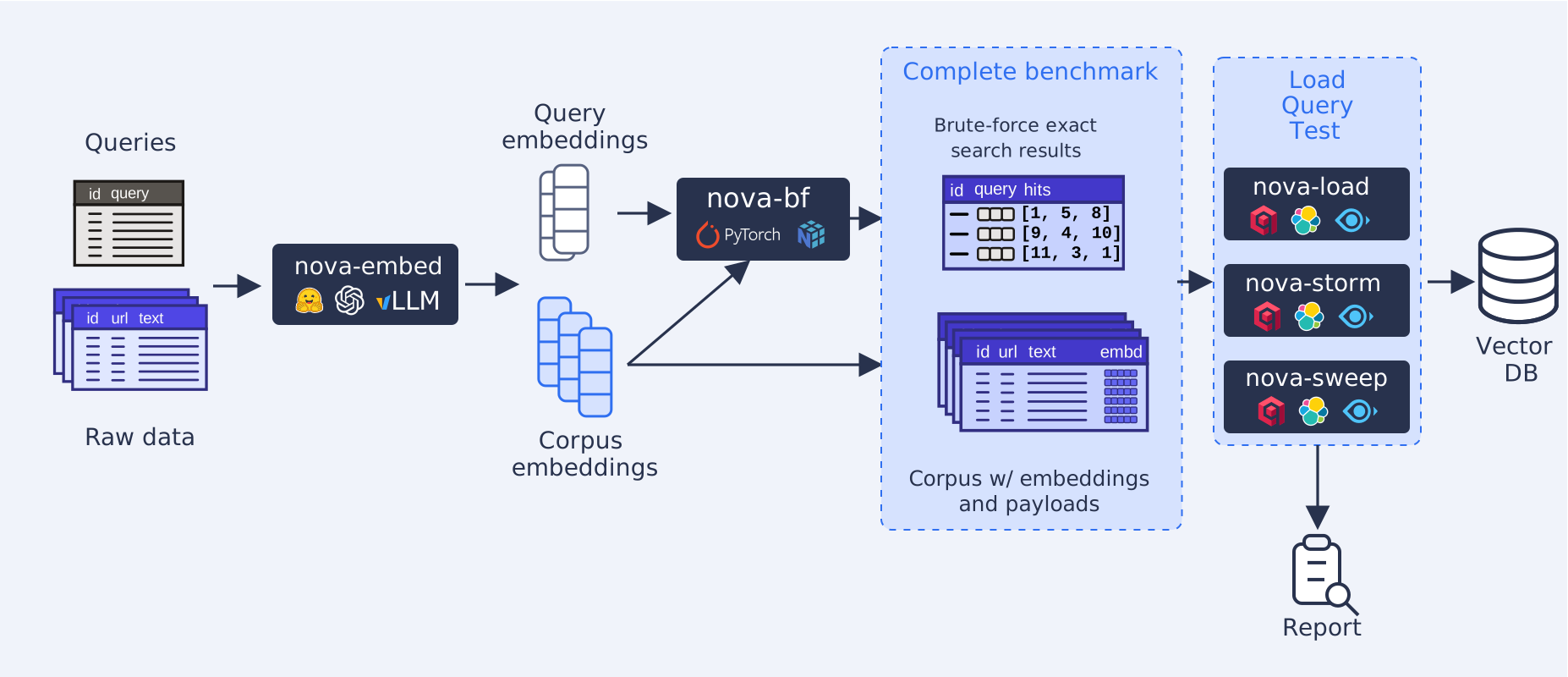
Supernova automates the four core phases of building and running a vector search benchmark: 1) embedding generation, 2) brute-force ground-truth calculation, 3) database loading, and 4) evaluation benchmarking.
Each phase is driven by a specialized module configured entirely via YAML files and designed for massively parallel execution:
nova-embed(Modular Embedding Pipeline): Unifies disparate backends (SentenceTransformers, FastEmbed, OpenAI APIs) and storage systems (Hugging Face, S3, Cloudflare R2). It operates statelessly without a central database—each worker uses its rank and world size to partition input data independently, achieving linear scaling across cloud and HPC environments.nova-bf(GPU-Native Ground Truth): Computes exact brute-force top-$k$ nearest neighbors across dense, sparse, and multi-vector representations without running out of memory. It streams data partitions from remote storage, uses custom fused GPU kernels for late-interaction scoring, and evaluates filters early on the CPU to prune irrelevant rows before GPU transfer.nova-load&nova-storm(Ingestion & Stress Testing): Handle downstream evaluation across backends such as Qdrant, Milvus, and Elasticsearch.nova-loaddrives parallel ingestion to test write throughput, whilenova-stormruns search workloads to track QPS, latency distributions ($p_{50}, p_{95}, p_{99}$), build times, and recall accuracy againstnova-bfground truth.
Distributed Compute with SkyPilot
To scale compute seamlessly across distributed infrastructure, Supernova integrates nova-dist, a controller-only module built on SkyPilot that handles cluster provisioning, job scheduling, fault tolerance, and cloud abstraction. Rather than hardcoding infrastructure logic into individual pipeline modules, nova-dist decouples job execution from hardware management. This allows nova-embed, nova-bf, nova-load, and nova-storm to scale linearly across AWS, GCP, Azure, Kubernetes, and Slurm HPC clusters using identical YAML configurations—massively parallelizing workloads across hundreds of GPUs without manual infrastructure overhead.
Acknowledgements
We extend our sincere thanks to Vultr for providing the raw compute infrastructure to generate the initial FineWeb-10B embeddings, as well as the SkyPilot and Hugging Face teams for building open-source foundation tools that enable operating at this scale.